SPX Scenario Update

The most important thing is to have a plan.

Timing is tough, so valuation and signposts are helpful.

As a benchmark, I use the S&P 500, I’m focused on the US, where I know stuff about the financial system and market function, and evaluate opportunities relative to that.

Previously, I put together a downside scenario worksheet, with pluggable items, so it can be easily manipulated for modified assumptions.

What was missing was an upside scenario, for once we clear this situation, in order to evaluate risk/reward on the benchmark. Previously, I’ve focused on investment opportunities with a 3x reward/risk ratio. I can gain 3x more than I risk, if I’m right. That’s merely one way to look at things.

I’ve now done a bit more work.

scenario-20200317

First, I’ve adjusted some of the core data to refresh with current and historical Bloomberg data, and most importantly, an ‘Index Weighted EPS estimate’. This also requires adjustment to the trailing EPS data, since these are not on the same basis. To do that I looked at the ratios and adjusted with a 1 yr back-window average of those ratios.

The upshot is some of the figures like P/E ratios are going to be nominally different from prior scenario sheets. But since ultimately I am looking at spreads like risk premium, that should wash out.

Second, I’ve grabbed an estimate out there of GDP declines of 5-8% annualized and a possible 30% decline in earnings. This seems pretty draconian. However, when I checked historical outcomes (still limited to the period 2000+, a big caveat), it turns out, this isn’t unreasonable, as I’ll show.

One upshot is this. As of yesterday’s close, given the really bad EPS decline scenario, the SPX was merely ‘fairly valued’ for a post-crisis recovery. So, as I advised a friend, I was not planning to buy the benchmark with substantial downside and merely at a fair value upside.

I followed the same principle to get an objective measure of upside potential – a naive lookback over the last 20 years.

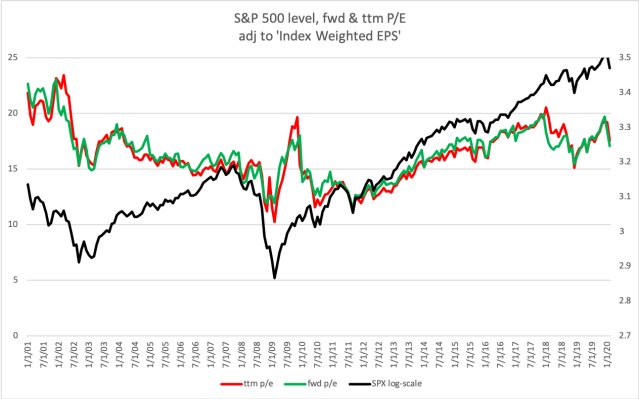
Here is the historical behavior of the simple S&P 500 index vs. its forward and trailing 1 yr P/Es, with the index level on a log scale (RHS):
spx-pe-20200317

Next, let’s take a look at how the risk premium I’ve discussed has behaved:

SPX-risk-prem-20200317

Remember, it’s month end, so you don’t see the extreme for March 2020.

If you eyeball it, you can see where my +3% excursion rule came from.

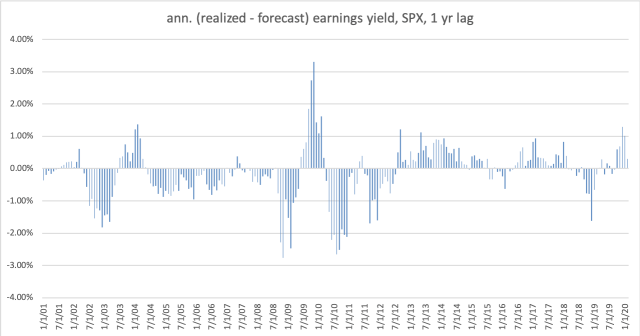
Just for shits and giggles, lets look at how the market tends to over or under forecast realized equity earnings yields 1 year forward (we take a 1 year look back at fwd P/E):
spx-ern-fcast-err-20200317

A very nice cyclical behavior. I’ve decided that given an overriding EPS forecast, I’m going to ignore this because I think it would be double-counting. Just keep it in mind.

Here’s an important series to gauge whether certain negative or positive forecasts forward for earnings behavior are conceivable:

SPX-ern-chg-20200317

From this, I concluded

  • the negative forecasts i’ve seen for -5-8% GDP and -30% earnings are not out of the question
  • a rebound off the bottom of +25% earnings seems reasonable, given a sharp recession

For good measure, I’ve started to factor in signals from gold, and deflating earnings with gold. I’ll have more on that in the future. In the meantime, here’s a look at gold-deflated SPX P/E behavior and the SPX/Gold ratio:

spx-deflated-pe-20200317

SPX-gold-ratio-20200317


Signposts:

We got

  • JPM and others to the discount window
  • CPFF re-established
  • PDCF with ridiculous collateral qualifications, including CLOs, CDOs and closet buying of equities!

We still don’t see

  • Utilization of the Central Bank swap lines
  • Effective implementation of fiscal actions (just announcements, meetings at this point)
  • Indications of USD shortage easing (FRA/OIS, etc)

Fed Nuclear Option vs. Collateral Shortage

Wow!

The Fed just announced a re-launched the Primary Dealer Credit Facility, AFTER having opened the discount window to the dealers in a separate action.

Holy Cow! The Fed will be taking anything not nailed down as collateral. That includes equities! Read the announcement carefully to understand the full terms. Let’s hope ‘the market’ likes this. In my view though, it goes to the point that there is a high quality collateral shortage. That’s why despite the Fed’s large headline repo offers, they aren’t being taken up on the full amount. Hence, the need to expand the qualifications on collateral.

I’ll update on repo in a separate post.

The use of the discount window by multiple large banks (8) is a smoke screen to cover for any of those with a problem plus all the numerous non-dealer and shadow banking entities out there now insolvent.

All one has to do is go back to the Fed’s historical data, which they don’t release until multi-year lag to look at who bull-rushed the window in 2008-2009 and you’ll get the picture. Everyone, and their mom.


Fed Emergency Action Sunday night

Any debate there is not a financial crisis is now settled. By the way, it is never the case that a financial crisis triggers a recession. It’s always the other way around.

The Fed has belatedly cut it’s Fed Funds target to 0-25 bps and now announced QE of $500 bn in treasuries and $200 bn in agency MBS.

Federal Reserve issues FOMC statement

The rate move is just a catch-down.

The QE is ‘over the coming months’ – so just formalizes increased POMO activity.

In its statement, the Fed makes reference to its alleged mandate, “Consistent with its statutory mandate, the Committee seeks to foster maximum employment and price stability.”

This is boilerplate b-llshit. The Fed’s mandate is to facilitate the financing of the US government as smoothly and cheaply as possible. It better address the latent malfunctioning in the US Treasury market.

Importantly, the Fed also dropped the rate at the discount window to the same, and extended the terms to up to 90 days. Here we come JPM! Also b.s. is that this is targeting consumer credit. Puhlease!

Discount window adjustment: Federal Reserve Actions to Support the Flow of Credit to Households and Businesses

Finally, the Fed has dropped the rate on and extended maturities for USD swaps with other central banks – hello Financial Crisis, we’re back! Although this is a move you want to see if you’re hoping they can stabilize the USD crunch.

[ EDIT: and, by the way, they’ve dropped the reserve requirement to ZERO! ]

Coordinated Central Bank Action to Enhance the Provision of U.S. Dollar Liquidity

No mention of a commercial paper operation re-activation yet, as rumored.


US Fed/Repo Update

As previously noted there is a very large implied problem that can be (has been) inferred from the Fed’s repo operations. As of close 03/13/20, my analysis puts that at $15 trillion, roughly 50/50 between TOMO/POMO.

JPM has apparently published an interesting note on a $12 trillion problem $12 Trillion margin call

Here is my updated sheet: repo-analysis-20200313

Please note an error was corrected which under-counted the cumulative POMO conducted since 4/2019. This developed relatively recently, and was caused by a limited range in the spreadsheet sum. Once we had more than a certain number of ops, the tail was being cut off. I’ve been paying more attention to TOMO though. But that is changing.

The Fed has stopped short of $400bn TOMO outstanding vs. it’s promised open lines, but Friday marked some furious multi-operation activity in POMO. There is apparently concern over leveraged treasury investors, macro funds being blown out, possible bailouts for Citadel, Bridgewater and Renaissance, and a gobal USD shortage.

Most of the primary dealers have reported their updated annual balance sheet figures. It now looks like, barring any unexpected update, they’ve de-levered over the past year, according to the end of period filings, down to about 20x total assets / total equity.

Notably, the wild and crazy HSBC entity that was running 134x (!!!) is now down to a ‘meager’ 84x. Wow those Fed guys are really on the ball.

Bank of America remains an enigma. Every broker dealer is supposed to report a Form X-17A-5 annually. BofA’s entity, known alternately as either BofA Securities, Inc. or BOFAML Securities, Inc. is not available as far as I can tell. My inquiries to BofA and the SEC remain unanswered. A strange situation. If anyone can shed light, please do.

Additionally, Citigroup and NatWest (an arm of RBS) are starting to look late. Still waiting on those filings. Citi is the more meaningful, in terms of size.

I am hearing chatter the Fed may begin a program to buy commercial paper Monday. I wouldn’t take that well. It seems like there’s fear of money fund runs as well.

Stay healthy!


US Repo Fed/Update Overnight

I’m pretty exhausted, how about you?

There’s been a lot happening and I’m not going to try to cover it all – there’s plenty of coverage out there. Anyone with specific questions just post a comment or hit me on email.

The big news at the Fed was the rollout of the ‘bazooka’ – twin $500bn repo ‘offers’ Mar 12 and 13, plus another bump in the ‘usual’ program.

Hey, look! An emergency $1 trillion line of (theoretical) support – remember the implications of the TOMO + POMO liquidity support that had been building up? Recall that in 2008, the culmination primary dealer bailout was $1.25 trillion par bailout of MBS. But that was versus a much lower notional problem… And it was effected.

So here is the latest worksheet for those keeping score at home: repo-analysis-2020312

I’m not sure how to classify the accepted parts of the new twin $500bn repo lines as they are done – should these contribute to ongoing implied problems, or be considered toward ‘solutions’? I don’t know. For now, I’m just rolling them in.

So, why didn’t it ‘work’ (in terms of generating a sustainable bounce yet)?

I can think of two reasons:

  1. As discussed in the past – the Fed can offer anything it wants. Watch what’s done, not any notional figures thrown around. As you can see in the worksheet, only part of the 1st $500bn got done today, and a relative fraction at that. Although TOMO out increased by more than 50%, still less than 1/2 the $500bn figure.
  2. Significantly, the reasons behind (or target) of this operation is DIFFERENT. According the the statement here Statement Regarding Treasury Reserve Management Purchases and Repurchase Operations, the Fed is now responding to a general Treasury market financing problem. Bank of America note covered the issues well. It looks like some big deleveraging events going on out there (no shit Sherlock!)

Until the next update…

‘Panic Scenario’ for S&P 500

Back in 2018, I did a ‘back of the envelope’ analysis of what’s the downside for stocks (as represented by the S&P 500) in the event of an unforeseen panic. That is, with hindsight, you can call it a panic, but most didn’t see it coming. That’s what makes it a panic.

This goes to having a plan. A key part of which is understanding valuation.

What follows is not a ‘call’, it’s a scenario to get an idea where valuation could go, and accounting for this in your potential investments. Following that, I’ve got a few takeaways.

Here is a worksheet showing the calculations for a ‘panic scenario’: panic-scenario-20200309

The key variable is an ‘equity risk premium’ – this boils down to how much excess return will investors expect and demand from equities over ‘risk free’ government bonds to compensate for risk.

Many use the 10 yr treasury as the risk free benchmark. I used the 5 yr, as who the hell can forecast 10 yrs out (let alone 5)?

The expected return of equities is deemed to be the expected earning yield, or 1 / forward P/E ratio

The big ‘insight’ in the whole calculation is that over the period from 2000 to present (I couldn’t get older data on short notice), if we look at episodes we label as a ‘panic’, we can see that the extreme expansion of the equity risk premium from the onset to the maximum excursion of this premium seems to be about 3%. Sounds like nothin’, right? It has a big impact, especially when the risk premium starts out low, like 2.9% as it (approx) did at the recent market top on Feb 19, 2020.

With this in hand we can do some simple calculations, given a few assumptions on where the earnings yield of the SPX can end up being priced, the implications for the ‘target’ price of the index, and a few rules for trying to pick longs at least.

In such a panic, an 8% implied earnings yield is not out of the question. That’s a 12.5x P/E, and with an assumption of a mild 5% decline in earnings estimates (analysts are always slow to adjust) the implied level of the SPX is 1700. Again, not a call but a scenario. Use your own judgement. And there’s nothing said here about overshoot.

My inclination is to look at potential longs through this lens, preferring things already reflecting such a compression in valuation. Obviously different stock trade at a premium or discount to the market, and that can be taken into account.

For instance, yesterday I did some light buying of double-digit yield stocks I have reason to think are solid and 1 stock with a low single digit P/E whose business should be off the hook the lower yields fall. Doesn’t mean they can’t get cheaper.

A few other guide posts I am looking at:

#1 For non-financial businesses, one indicator of a good business is Return on Assets. Very high number here are often unsustainable, so companies with good records here show evidence of a moat. For example, in tech, look at MSFT, ORCL, GOOGL – although this says nothing of valuation. But clearly, consistent high ROA businesses may deserve higher multiples. At ORCL, Larry Ellison still owns a huge stake and IMHO was one of the most consistent value creators over time. The company had an early brush with bankruptcy and learned from it.

#2 Use Total Assets / Total Equity as a ‘cleaner’ proxy for leverage. This can also reflect over-valuation of assets. In the GFC, I looked for around 3x max.

#3 Current and Quick Ratios may reflect a company’s resilience to short term cashflow turbulence. The higher the better. Under 1 and it starts to get dicey.


US Repo/Fed Update

The gnomes at the NY Fed ramped up to $203bn net temporary open market operations (TOMO) outstanding. A day late and a dollar short. These guys are so behind the eight-ball it’s a travesty. Nevermind they blew the bubble in the first place. It makes me wonder if they are part of the Biden campaign. By the way, get ready for President Joe.

All in, they now stand at TOMO 1.4x the est. Primary Dealer equity and an astounding 4x that equity in combined TOMO and cumulative permanent open market operations (POMO) since Apr 2019.

repo-analysis-20200309

In a big bag of I-told-you-so, remember that figure of the assets at risk implied by these operations thru the Primary Dealer leverage? Here’s an old figure on the losses from the top, in one of the swiftest corrections ever: value lost. $6 trillion. Granted the market first rose from Sept 2019. But, we may not be done yet and as previously noted, the Fed may be able to shift losses, but they eventually land somewhere.

In a further signal of “we have no idea what the f-ck we’re doing and we’re making it up as we go along”, the Fed posted a modified repo plan today to notify the market of intent to increase: Statement Regarding Repurchase Operations

IMHO, here’s what needs to happen, stat, to stand a chance of stabilizing things.

First let me state I’ve never been a fan of government intervention. This is just a practical analysis from an investment standpoint and based on how markets have been manipulated in the past.

#1 There better be emergency meetings going on NOW, not leisurely on Wednesday when ‘Wall St. executives are invited to the White House’. I’d be shocked if there are not emergence meetings being run by the Fed right now.

#2 Trump, if not right before, is right now. The Fed target rate is now above the entire treasury curve. They need to drop it under. Reasserting an old reality, in my opinion, the Fed controls nothing. The market is dictating a lower rate.

#3 Given where rates are, the government should take advantage of the circumstance and ramp up issuance of ‘coronavirus bonds’ (that’s just my nickname). The ducks are quacking, feed them. Raise funds for whatever these stimulus plans are to be discussed tomorrow, or fund the deficit. Whatever.

#4 If you’re going to offer corporate tax credit, do so for MAINTAINING event planning, etc. The lemmings are all following each other off a cliff and cancelling everything. Guaranteed recession if not turned around.

#5 Somebody stuff a sock in Trump’s mouth and lock down the coronavirus status communications into a cohesive, transparent process. The panic is worse that the virus. And realize to a guy with a hammer, everything looks like a nail. Realize if you work for the CDC, the NIH, etc you are likely looking to make hay while the sun shines. Someone needs to put a tight control on what these people are saying. I’m chicken little, for Christ’s sake, but this is STUPID! Never thought I’d agree with Elon Musk…

#6 Get it over with and service JPM (and maybe others) at the discount window. We all know it’s coming. And go big or go home.

CDC investigating new illness!

At a press conference early this AM, the CDC announced it will begin investigating a mysterious new illness that appears to have spread among traders in financial markets. The primary symptoms are uncontrolled projectile vomiting and fever induced panic.

According to the CDC, preliminary indications suggest it may be correlated with high leverage.

Sell when you feel like a genius.

Buy when you feel like you’re going to puke.

I’m doing some light buying today. I don’t think severe risk has passed, but neither do i have a good read.

I believe a bottom may be at hand when we see headlines of JPM running to the discount window, as this has been telegraphed, so they should just do it already.

I’ll elaborate more in another post but a couple of rules of thumb for buying –

  1. Assume a market (SPX) earnings yield of 8% to be priced in at extreme panic – so what you buy should be priced accordingly (account for premiums or discounts to that). Can’t tell you if we get there, but past behavior says it’s possible.
  2. Be careful of leverage (duh!). Some traditional value guys have a blind spot for that. My rule in the GFC was anything over 3x Total Assets / Equity gets risky, and a bit higher and you’re into closet financials (if not outright).


Keep calm and carry on!

US Repo/Fed Update 03-06-2020

As a quick recap, to 03-06-2020, Fed TOMO is back up to ~ $175BN or 1.2x est primary dealer equity, which I’ve begun to update for new annual filings. This was after a brief peak up to nearly $200bn as the coronavirus-inspired panic began to hit.

Primary dealers look like they’ve de-levered by around 1x, presently to 20.1x, if trend holds with updated filings.

Never-the-less, inclusive of POMO, outstanding liquidity for implied asset support is now up to 3.9x est. primary dealer equity. This isn’t necessarily positive, as it’s an implied problem.

Note that all after-the-fact attributions are just that. The virus may be a catalyst but not likely the entire cause, IMHO.

Most worrisome of all to me in the immediate term is the cascade downward in US rates, including the 10-yr below 1%. That represents a ‘stampede’ to safety and has been an indicator of bad things for equities in the past.

As previously noted, watching the Fed outside of repo is important, and now we’ve got a red alert, which I think has contributed to the market nervousness.

[NOTE: the Fed was so behind in its emergency 50 bps rate cut, I entirely overlooked that when originally writing this note! Yep, they did. And they were way behind the market.]

Specifically, it appears the groundwork is being laid for JPM, and possibly other banks to head to the discount window once again. I’m not buying the b.s. argument it’s time to dispel the stigma. If you know what the discount window is for, you’ll understand why there’s a stigma. This is exactly what happened when Bear had collapsed and the Fed was backing up JPM to do the takeover. They lent to JPM through the discount window – which is part of my view that it was JPM that was bankrupt (along with many others) in 2008. Only JPM was too big to fail.

The Fed’s Randal Quarles made remarks on Feb 06, 2020 surfacing the issue: Quarles

Quickly picking up the football, JPM’s CFO commented on their recent investor day, they’d likely soon tap the window: JPM Investor Day – Firm Overview – Feb 25, 2020

Finally, the OPEC breakdown and ‘declaration of war’ in the oil market by Russia is a big negative for U.S. high yield and credit. That ain’t gonna help anything. The bulls argue it’s a discount for consumers. However, in my experience in financial markets, which is admittedly shorter than some very successful bulls, the negative demand implications signaled by lower oil prices are more weighty to me than any proposed discount to consumers or businesses.