About this pandemic

Back in early 2020 as the headlines and panic began to spread I came up with a perspective that still seems to be true today.

We have too much faith in science and not enough respect for nature.

If you were reading books in the 1980s (e.g. The Hot Zone) you would have known something like this would happen eventually, one way or another and will happen again.

The notion that we can snap our fingers and scientists will come up with a silver bullet vaccine on-demand is pretty laughable.

It’s pretty impressive we got anything as fast as we did. Trusting that any one shot in the arm is going to provide ‘sterilizing immunity’ is a fools errand.

See, it is a Financial Crisis!

Well, I didn’t have long to wait after my previous note this evening.

The St. Louis Fed just announced it has tweaked its Financial Stress Indicator (overdue) and it now shows stress levels above the point of the Lehman failure.

And specifically, the explanation notes:

One type of risk prominent in the 2008-2009 financial crisis is once again present—in the current COVID-19 (novel coronavirus) crisis. It is the inability of many financial institutions to secure funding to finance their short-term liabilities, such as repurchase agreements (repos). This type of risk is known as “liquidity risk.”

Forewarned is forearmed.

US Fed / Repo, QE & Bailout Update

The NY Fed has rapidly reversed out it’s outstanding TOMO levels in just the last few days by conducting successively larger Reverse Repo operations with any of qualified Banks, GSEs or Money Market Funds. There has been a massive rush out of corporate bonds and stocks, of course.

Concurrently, the Fed has been busy redeploying the funds, and then some into POMO – or QE-Infinity as some are calling it now, not to mention, very importantly, Central Bank Liquidity Swaps for which we finally got the first week’s worth of activity ending 03-25-20. A mere $200 bn 😉 Still, USD funding looks tight.

[Note: this chart and the file are as-of 03-27-2020 despite their label. will be corrected]
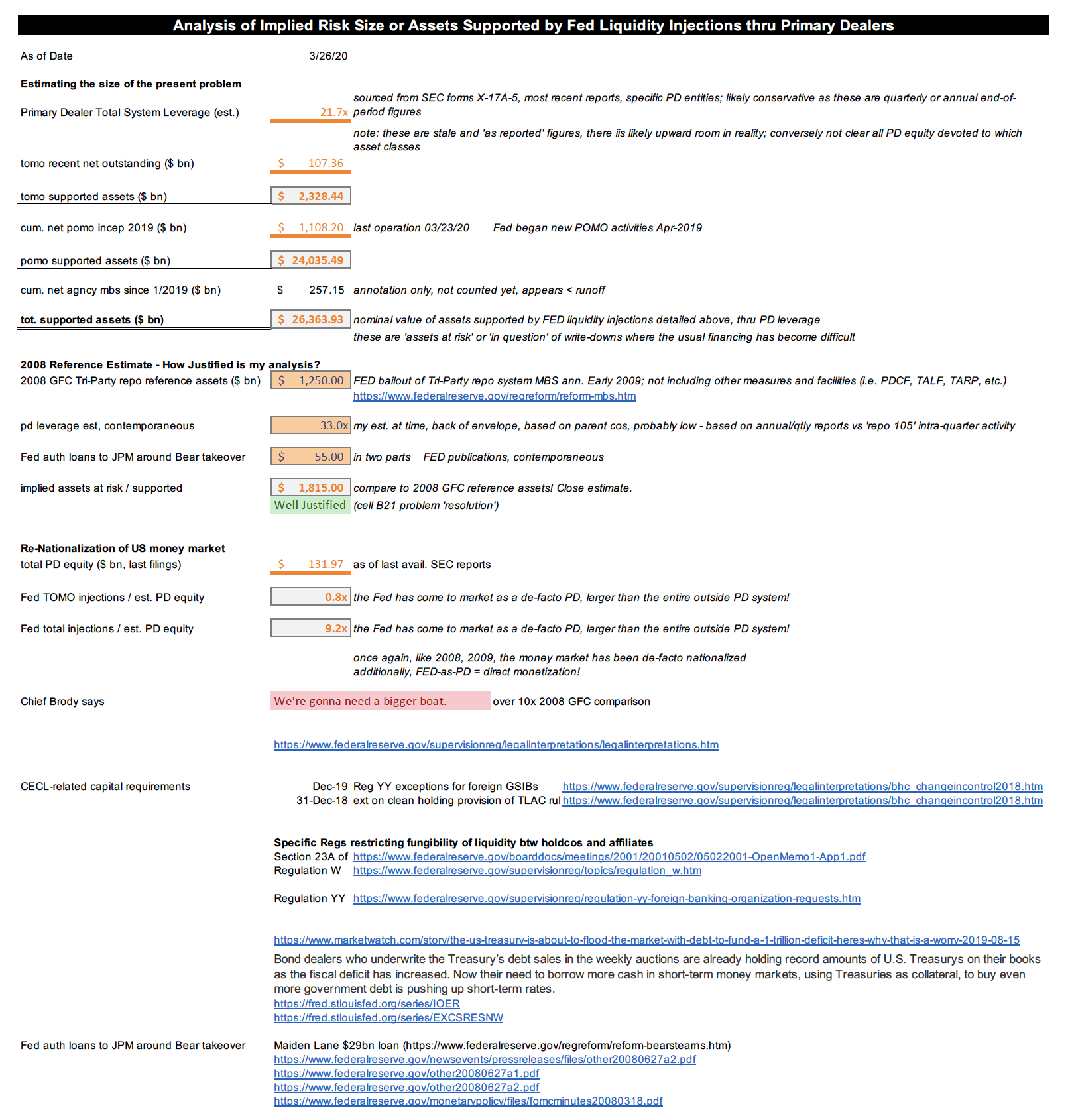
Screen Shot 2020-03-28 at 9.13.03 PM

repo-analysis.-20200327

Despite the announced CPFF, all appearances are the commercial paper market is still in distress, regardless of how good the recent snap-back rally in stocks might make you feel. There’s been a massive run by corporations to draw down bank funding lines, exceeding even the GFC of 2008.

Similarly, despite the announcement of support for ABS and the MBS markets (commercial mortgages), an examination of the changes in the weekly holdings of the Fed’s SOMA shows little net buying there yet, while POMO has caused holding of notes and bonds to explode upward propelling the Fed’s balance sheet to new highs.

I categorically DO NOT BELIEVE the assurances from various financial market pundits and authorities that despite the economic crisis induced by the pandemic, this is not a financial crisis like 2008. It is EXACTLY so, based on all this activity we’ve now seen to date. And the reason is financial crises do not cause economic crises (as far as I am able to tell from reading historical accounts and studying data from more recent US history from 1917 on). Causation is always the other way. The financial crisis is merely the financial system and asset prices catching on to economic reality.

The only question is can the US Treasury and the Fed, with the benefit of our savings, keep the financial system standing up.

Take your pick from among estimates being circulated of the total cost of this bailout. From the $2 trillion of the recent bill, to estimates such the Fed’s balance sheet going $9 trillion this year (at the rate they are going, I could believe it).

Now, do those multi-trillion estimates of assets ‘in trouble’ implied by the Fed’s TOMO and POMO activities over the past fews months I’ve been pointing out make some sense to you?

Stay Healthy!

US Fed / Repo / Primary Dealers Update

The Fed is moving around some of its support ops, drawing down TOMO significantly today, but continuing to ramp POMO and agency MBS purchases. Overall, TOMO + POMO remains at or near highs. repo-analysis-20200325

Elsewhere the Fed has now introduced some obscurity around the PDCF, and likely other programs. To do this, they’ve altered the H.4.1 report, Factors Affecting the Balance Sheet, where they’ve rolled the line item ‘Loans’ from Table 5 into ‘Securities, unamortized premiums and discounts, repurchase agreements, and loans’. This hides the exact size of what they are doing.

Meantime, we’ve got most of the filings now on Primary Dealer broker/dealer entities. Of these, only Daiwa and Barclays are still due to report (early June 2020). Recall that Ronin Capital, a CME clearing firm, failed last week and at the same time we’ve started to see the Fed issue waivers of Regulation 23A and W, allowing banks with access to the Fed to step in and try to bail out their broker/dealer affiliates by exceeding normally limited asset purchase limitations. So why should this make you nervous? For example, an entity levered 50:1 would have its equity wiped out by a 2% decline in its asset prices. No surprise then that Ronin had a problem, given the wild volatility going on everywhere. If you’re 22:1, then a 4.5% decline in your asset values wipes out your equity. And you’ll fall foul of minimum capital requirements before it goes to zero.

Here is the latest state of the primary dealer system. pd-leverage-20200325

Once again, I ask, HOW IS HSBC STILL PART OF THAT SYSTEM?

Also, it would take up too much space here to list every new acronym the Fed has activated to go out and buy stuff with your savings.


Financial Crisis Redux

I am unhappy to report bad news.

The Fed has now broken the glass.

Just before the failure of the CME clearing firm on Friday, the Fed has BEGUN to issue waivers to Reg 23A to banks with broker-dealer affiliates, just like in 2008, before the collapse.

The broker-dealers are in trouble without access to their affiliate banks Fed access.

Additionally, one of the letters concerns Money Market Mutual Fund assets – I’ve never seen that before.

And this time, they are not naming the banks.


Downside Scenario – Sellside Revisions

Looks like I was ‘ahead of the curve’ on this one and did a decent job of guesstimating the expectations of effects on earnings.

A Goldman, Sachs update calls for a 33% decline in EPS.

It could end up worse or better, but for the moment, looks like my downside figure was a decent early estimate of the negative possibility.

It’s my personal view that the government (Federal and State) response to this exogenous event is now actually doing more damage than we’d see from the virus in the first place. This kind of irrelevant as I’m making investment evaluations in this thread of postings and that has to take into account policy actions.

Looking at the post-crisis upside potential, in the short term from a bottom ( i.e. 1 yr expectations out from a bottom ), my scenario puts a roughly 2500-2600 ‘fair value’ on the SPX including the effect of a +25% rebound in EPS.

Screen Shot 2020-03-22 at 6.16.50 PM

CME Clearing Firm Failure

Ronin Capital LLC has failed to meet CME clearing requirements and had its portfolios liquidated at auction this morning.

This firm had been levered 51x assets/equity as of a March 2019 filing! Not unlike some Primary Dealers, who also happen to be CME clearing firms. This means a 2% decline in asset value wipes out the equity. We’ll never get to see it’s filing for Dec 31, 2019…

Here’s a list of clearing firms associated with the CME.

The dominoes are falling.

I am watching closely to see if/when the Fed begins to wave regulations allowing its member banks to lend more freely to their associated broker/dealer entities who don’t have direct access to Fed lending.


US Fed / Repo Update

The fog is getting thicker… and the Fed’s balance sheet is getting larger. We are now into the acronym salad stage of the panic. The difference between now and 2008 is we had a lot of acronyms flying before the sharp selloffs.

I am a couple days late here flagging the MMLF intended to forestall runs on the money market funds and another ‘breaking of the buck’. Once again we are reminded of the superior quality of short term treasuries to holding money market funds for ‘cash’. Short term treasuries don’t have gates.

Chalk the MMLF to another positive signpost on the Fed intervention track. It’s not a sign of panic. The panic was already there. It’s a response.

Repo activity is just … to the moon. Does that describe it? It’s still not $1 tn. But POMO is headed rapidly up while TOMO is fluctuating. repo-analysis-20200319

An interesting coincidence – my worksheet now implies ~ $24 tn in ‘troubled assets’. I noted in this survey of recent market action, global assets seem to have lost about $25 tn in notional value, by their assertion. Just a random coincidence, I am sure. Yeah, I know, the Fed is not the only game in town. Never-the-less they are the pied piper for the time being, leading the rest of the USD-based system over the cliff.

How are Central Bank swap lines doing? Announcements are good for sure, but let’s look at reported Central Bank Liquidity Swap Operations. Unfortunately there is nothing meaningful reflected yet. ECB usage is totally normal, as I’ve had eyes on this before. ECB is typically a big end of quarter user and this level is typical ex-that. Keep watching FRA/OIS for indications of the money panic.

Stay healthy.

Avoid using the terms ‘social distancing’, ‘shelter in place’ or ‘flattening the curve’.

Just practice healthy habits and don’t use irritating catch-phrases that reflect media brainwashing.

Possible Short-Term Sentiment Catalysts

Two items to pay attention to may improve sentiment vs. the virus pandemic at least for a short period:

Possible Treatment for COVID-19 is Chloroquinine – while this hit mainstream TV news last night (first time I saw it), it began to emerge a couple of days ago that this venerable non-patented anti-malaria treatment may have efficacy against the virus.

A possible S-curve vs uninterrupted exponential spread. I had been discussing my personal opinion this may end up being the case. I’ll save you my arguments, since I’m not a virologist, but I did stay at a Holiday Inn last night. An analysis of data suggests a power law may be in play vs. a pure exponential. In an irony only I may appreciate, this is the same principle behind the fallacy of the quants in finance – that asset returns can be characterized by a log-normal distribution, when in reality the tails are too fat, because they are governed by a power law ( which in turn is determined by the effects of disturbance when a smaller population of large pools of capital re-allocates ). If you’re a true math geek, this all goes to Zipf’s law, which is everywhere in population statistics.

So have this on your radar for a possible short-term positive impact on market sentiment.

US Fed, Repo, Primary Dealer Update

Fed TOMO dropped a bit from yesterday but they’re making it up and then some in POMO.

Outstanding support under TOMO now stands at 3.3x updated primary dealer equity and a stunning 7.9x for TOMO+POMO.

Read it and weep: repo-analysis-20200318

Primary dealer leverage estimate (pd-leverage-20200318) moves up to 21.7x mostly as a result of locating information on BofA Securities, Inc., which is somewhat more levered than the inexact guess from the 10-K of the parent company previously used.

Note that the figures for primary dealers are general figures for broker-dealer entities as required to be filed under US securities law. It is impossible to tell what % of assets devoted to primary dealer activity.

I did a bit of sleuthing around the new Primary Dealer Credit Facility off hours and captured this image of collateral deposits being conducted:

garbage-dump